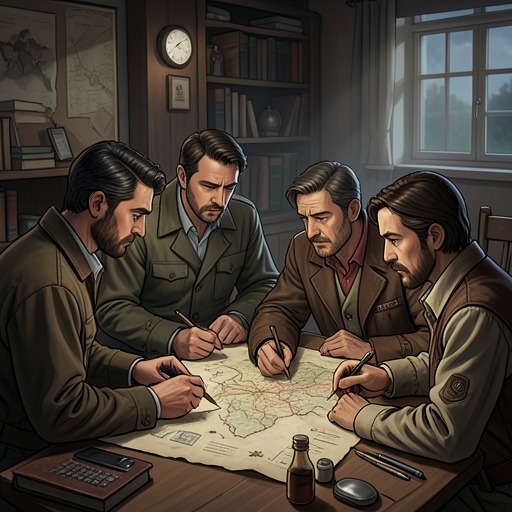
Post-apartheid South African intelligence integration
Heart of the HunterPost-apartheid South African intelligence integration is a state-building project conducted amid institutional mistrust, political uncertainty, and an immense, contested archive. Its goal was to consolidate rival services and their records into a coherent system, but the work also forced former adversaries to confront what each had kept, concealed, or deleted. The effort’s central contradiction is that a new intelligence service was meant to begin without the past, while its creation depended on collecting and judging that past in extraordinary detail.
A merger under pressure
After the elections, intelligence services were brought together in a climate described as chaotic. There had been two or three branches on one side and still more under the apartheid regime; people within the services did not trust one another, and covered up, lied, and competed. Consolidation was presented as a practical necessity: the divided structure cost more than had been budgeted, and officials needed to impose order. The proposed remedy was to divide the work into projects and compartmentalize it, an administrative response that contained the danger of dealing with a shared archive by keeping responsibility narrowly assigned.
The political aspiration was more sweeping than the method. The Director sought to build an outstanding intelligence service, a new institution without a past, while anticipating resistance and undermining both inside and outside the country. Yet the records themselves made that clean break impossible. The merger required cooperation between people trained by opposed systems and asked to handle information gathered against one another. A former National Party government employee recalled that seeing what the former enemy knew, and revealing what his own side had held, felt surreal. The old division between enemy and colleague had changed faster than the habits built around it.
Johnny Kleintjes and the archive project
Johnny Kleintjes was recalled to help with the transition and became project leader for integrating the former liberation movement’s and former regime’s computer systems and databases, a role he held from 1995. His experience suited the task: he had established the African National Congress’s computer systems in London, Lusaka, and Quibaxe, and had earned the nickname Umtkakathi, meaning wizard, for his computer skills. His own career crossed political and technical worlds. An exile from 1972, he had worked in the movement’s offices, received intelligence training in Odessa, and later became responsible for joining systems that had been built on opposite sides of the conflict.
The scale was daunting. The project covered an estimated 400 to 500 gigabytes, ranging from personal information on members of the public to weapons systems, informants, and double agents. The archive extended from Infoplan in Pretoria to Denel and records associated with the former regime’s security police, the South African Secret Service, and Military Intelligence (South Africa), as well as the African National Congress’s systems in Lusaka and London. Kleintjes was expected to sort this mass of material, remove information that could cause trouble, preserve what remained useful, and create a central, uniform platform. Those were not neutral technical operations: each required decisions about what the new state should retain, what it should erase, and who might be harmed by either choice.
Secrecy, deletion, and private backups
The integration process did not reliably preserve the records it was meant to unite. Groenewald recalled that some members of the team could not overcome years of conditioning around secrecy and the division between us and them. Operational records disappeared, particularly material individuals did not want counted against them. When Kleintjes realized that records were being deleted, he began making backups. After one backup tape went missing, he started taking work home. The archive was therefore being shaped not only by formal decisions, but also by fear, self-protection, and the physical loss of copies.
Kleintjes’s daughter, Monica, described another source of unease. While her mother was ill, she kept house for her father and saw him work on data at home, sometimes through the night. He had told her that some orders seemed wrong and that Nelson Mandela and Nzo would not approve of them. She did not know what was on the disks or what he intended to do with the information. From what she could see, he may not have handed the material in and may have been trying to sell it; her account presents this as suspicion, not as established fact. The distinction matters: the backups might be understood as preservation amid disorder, but taking records outside official channels also made their purpose and destination uncertain.
Controlling information after the merger
The instability of digital records shaped later procedures. Rahjev Rajkumar explained to Janina Mentz how easily electronic information could be copied and distributed: disks, e-mail, networked systems, and hacking all created routes by which information could escape. The prescribed safeguard was a single paper copy. Rajkumar’s section had four typists working in a video-monitored room. Staff signed digital and magnetic tapes out, transcribed them onto paper, then signed the tapes back in; the paper record went to an access- and temperature-controlled library, while the digital tapes were deleted. The system sought to limit circulation by reducing the number of usable copies, turning document handling into a tightly supervised chain of custody.
Mentz’s authority within this new structure was itself tested. When she assembled her team for the Director, its members were predominantly male and came from backgrounds in which male authority was taken for granted. They tested her leadership, but crude language and thinly veiled anti-feminism did not dislodge her. Her appointment embodied the service’s attempt to reorganize its personnel and authority, even as the institution remained marked by inherited hierarchies and suspicion. The question of control thus applied both to the records and to the people entrusted with them.
What the records could not settle
The merger’s limits appear in the later search for Thobela Mpayipheli. A review of MK files found no record of him, and a search of files in Pretoria likewise failed to locate him. At the same time, investigators identified a registered home address in Mitchell’s Plain belonging to Orlando Arendse and found that Monica had contacted Arendse while trying to reach Mpayipheli. These findings show how official records could offer fragments and leads without producing a complete account of a person. In a system assembled from divided and sometimes disappearing archives, an absence in the files was not the same as proof that no relevant history existed.
The integration project is therefore more than a technical consolidation. It joins a political demand for a new service to a practical dependence on the records, loyalties, and habits inherited from the old order. Its single-platform ambition promised coherence, but the contested backups, vanished records, restrictive handling rules, and unsuccessful searches expose how much remained uncertain. The state could reorganize its databases; it could not make their contents, omissions, or custodians politically innocent.